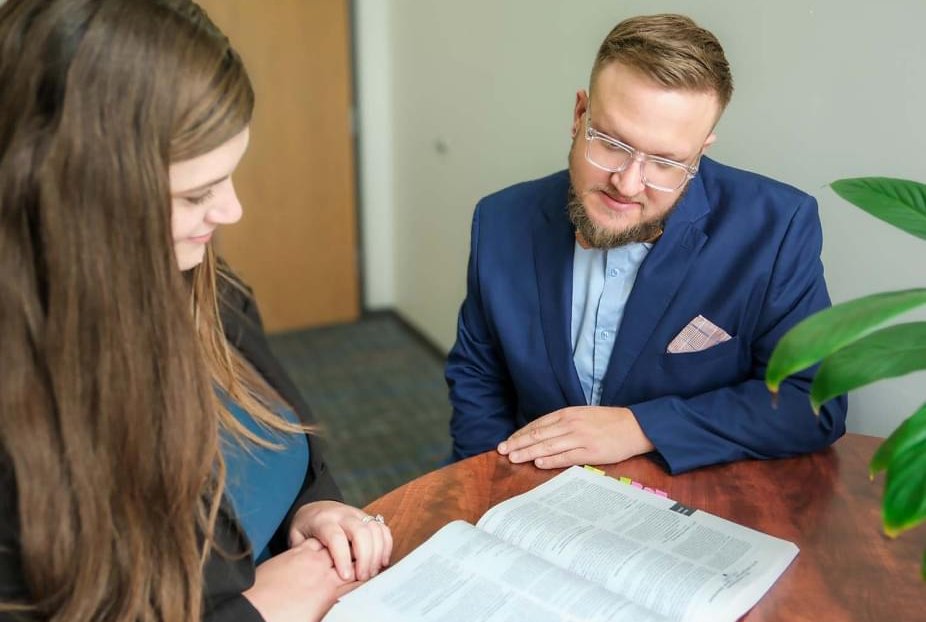
Every person deserves access to excellent legal support.
At the Tulsa County Public Defender’s Office, we fight for the rights of every person we serve through vigorous, compassionate, and creative legal advocacy.
As a client of our office, you will have the best legal representation available in Oklahoma.

How can we help?
-

Use our case lookup tool for up-to-date information.
Case Lookup
-

Explore resources for housing, mental health, employment, and more to support you.
Resources
-

Reach out to your attorney directly for personalized support on your case.
Contact Us
Facing a criminal charge and need help understanding next steps?
Select the type of charge below to learn more about the process and what you can expect.
Step 1
Arrest
Once arrested, you are taken to jail. Ask for an attorney. Do not talk to the police or consent to a search unless your attorney present.
Step 2
Booking
The booking process can take several hours.You can post bond at this point, and get out of jail, unless it is a domestic violence (DV) charge. DV arrestees are held without bond until bond docket.
Step 3
Bond Docket
A hearing is held within 24 hours of arrest and booking. The judge will determine the bond amount.
Step 4
Arraignment
The formal “reading” of the charges. If probable cause exists for the charges, the judge sets a time for your Jury Trial Sounding Docket (JTSD).
Step 5
Jury Trial Sounding Docket (JTSD)
Your first appearance after arraignment. A rec is conveyed to you, which you may accept (plea) or reject (fight). If you choose to plea, this is the end of your case. If you want to fight the charges and go tor trial, the Judge sets a trial date.
Step 6
Pre-Trial Motions
Leading up to the trial, the prosecutor and you public defender will prepare and file pretrial motions.
Depending on the circumstances of the case, these motions might include a motion to exclude or include specific evidence, a motion to dismiss the case, or a motion to move the trial to a different venue.
Step 7
Trial
You can have a jury trial or your public defender can request a bench trial before a judge. The prosecutor can object to a bench trial and demand a jury trial.
Regardless of the type of trial, the prosecutor must prove its case beyond a reasonable doubt to convict you. In a jury trial, all six jurors must concur.
Step 1
Arrest
Once arrested, you are taken to jail. Ask for an attorney. Do not talk to the police or consent to a search unless your attorney present.
Step 2
Booking
The booking process can take several hours.You can post bond at this point, and get out of jail, unless it is a domestic violence (DV) charge. DV arrestees are held without bond until bond docket.
Step 3
Bond Docket
A hearing is held within 24 hours of arrest and booking. The judge will determine the bond amount.
Step 4
Arraignment
The formal “reading” of the charges. If probable cause exists for the charges, the judge sets a time for your Jury Trial Sounding Docket (JTSD).
Step 5
Preliminary Hearing
Your first appearance after arraignment. The prosecutor (the “State”) puts on witnesses and evidence to show two factors are met:
- A specific felony was committed
- That you likely committed said felony
This hearing may be dropped (often to “lock in” a deal with the prosecutor), but the prosecutor may demand a hearing. If the judge finds the two factors are met, you are “bound over” on the charges, which means you must go before the district judge for District Court Arraignment.
Step 6
Motion to Quash
If you had a preliminary hearing and was bound over on the felonies, your public defender may write a motion for the district judge, asking that the district judge find differently than the judge did at the preliminary hearing and “quash” (suppress) said felonies.
Step 7
District Court Arraignment
Like the initial arraignment, the district court arraignment is a setting for the district judge to read your charges. At DCA, you will typically be set for trial or set for some other disposition.
Step 8
Pre-Trial Motions
Leading up to the trial, the prosecutor and you public defender will prepare and file pretrial motions.
Depending on the circumstances of the case, these motions might include a motion to exclude or include specific evidence, a motion to dismiss the case, or a motion to move the trial to a different venue.
Step 9
Trial
You can have a jury trial or your public defender can request a bench trial before a judge. The prosecutor can object to a bench trial and demand a jury trial.
Regardless of the type of trial, the prosecutor must prove its case beyond a reasonable doubt to convict you. In a jury trial, all six jurors must concur.
Our approach
Clients are at the center of our public defense work.
We practice a community resource model of public defense that ensures the individual clients and their needs—legal and non-legal—are always core considerations. The community resources that we connect clients to are primari
Our Model

We provide our clients with high quality, client-centered legal advocacy.
High quality, client-centered legal advocacy can empower clients to make informed decisions, lead to faster resolution of cases, and achieve the best outcome for their individual situation.
Our Office